Frontier llm-router
Frontier llm-router is a Kubernetes service for OpenAI-compatible routing: local-first escalation, role-based access, budgets, cost caps and spend logging.
The Frontier llm-router is its own Kubernetes service. It runs as a pod in its own namespace on the Federal Frontier FMC (Fleet Management Cluster) or another conformant Kubernetes cluster, such as Amazon EKS in AWS or RKE2 on-prem via CAPO, and sends model calls to llm-d and vLLM inference pods. Its callers, including Compass chat and Frontier SRE dispatch, get one OpenAI-compatible endpoint. Compass also hosts the FinOps and Admin screens that read and configure it. It sends each request to the cheapest model that can do the job, from self-hosted open-weight models up to commercial frontier models from leading AI providers. It also enforces who may use which model and keeps spend inside budget.
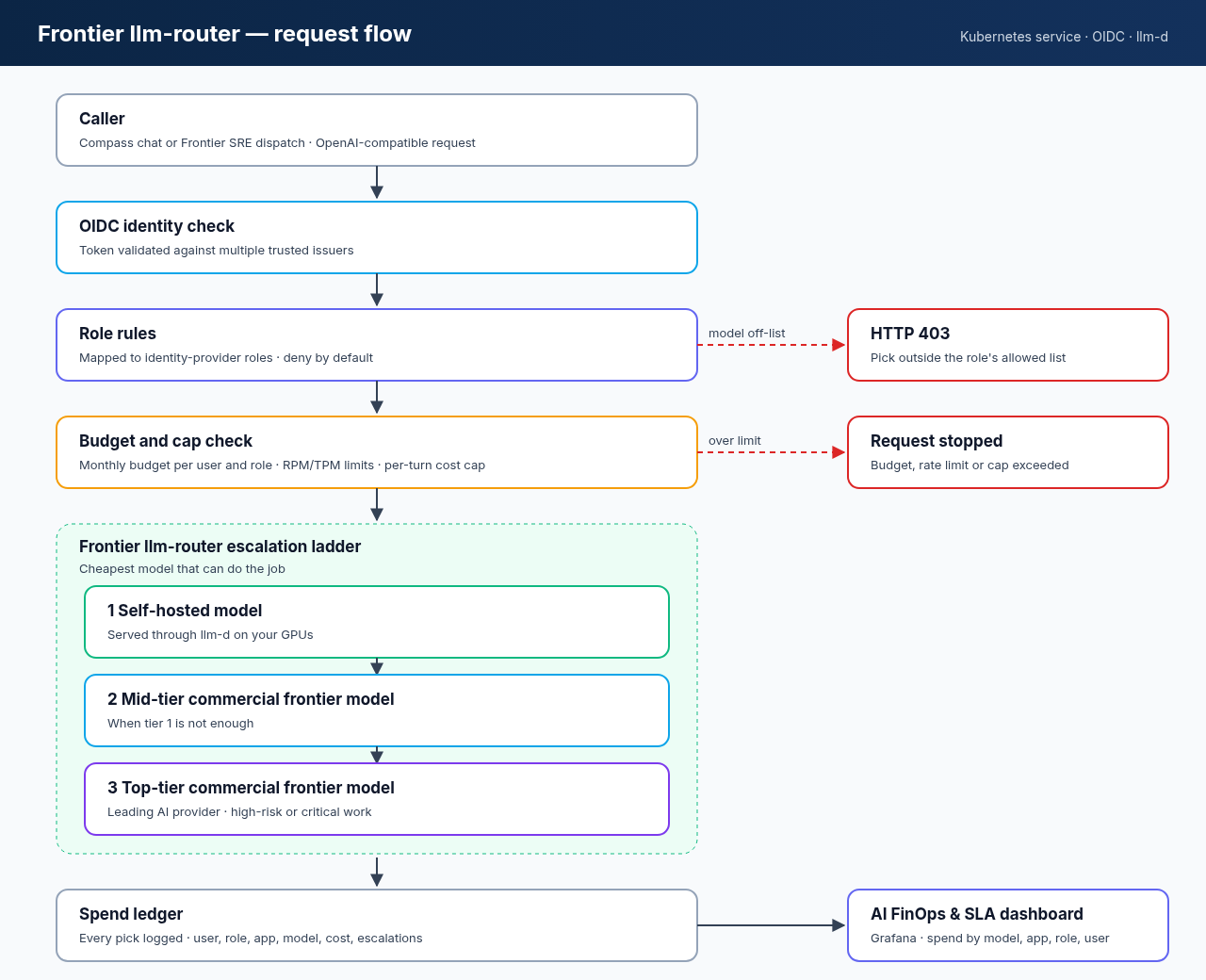
Cheapest-first escalation
| Tier | Model | Used for |
|---|---|---|
| 1 | Self-hosted, served through llm-d | First choice for every request |
| 2 | Mid-tier commercial frontier model | Escalation when tier 1 is not enough |
| 3 | Top-tier commercial frontier model from a leading AI provider | High-risk or critical work |
Self-hosted is the low-cost first tier. The router escalates to frontier models when the task needs it, under the same budgets and caps.
Per-role model access
Access is deny-by-default and mapped to identity-provider roles. A request for a model outside the role’s allowed list returns HTTP 403. Every pick is logged.
Identity
OIDC token validation supports multiple issuers.
Budgets and caps
| Control | Scope |
|---|---|
| Monthly AI budget | Per user and per role |
| Rate limits (RPM/TPM) | Per user and per role |
| Per-turn cost cap | Each model call |
| Per-session dollar cap | Automatically stops a runaway agent’s job |
Admins manage all of it in the Compass Admin AI Spend panel.
To track spend, budgets and forecasts, see Compass FinOps.
AI FinOps & SLA dashboard
The Grafana AI FinOps & SLA dashboard shows spend by model, app, role and user, plus escalations.
Frontier SRE agents
Frontier SRE agents (OpenCode and Claude Code runners) send every model call through the router under their own service identity and budget.
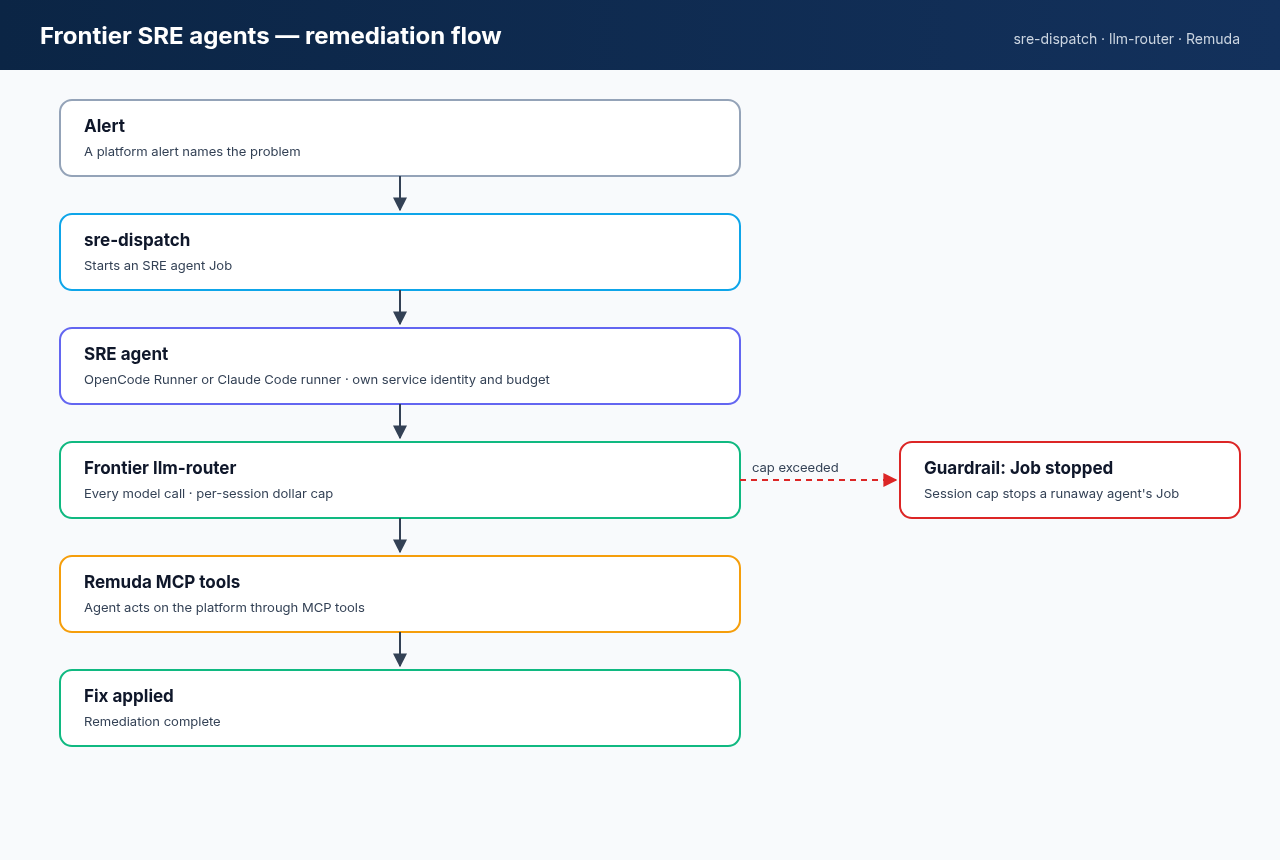
In a live ImagePull remediation, the agent finished in about 2.5 minutes for about $0.07.